
Reflection activity: Thinking of your current or a past workplace provide specific examples of each hierarchy of control – see Appendix B.
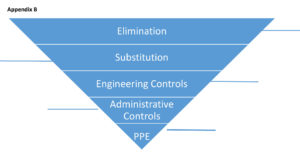
In my unit at the hospital, examples of the hierarchy of controls that can be seen in our everyday infection prevention practices include:
Elimination: Patients with infections such as MRSA or C. Difficile are placed in private rooms to reduce exposure to others on the unit, and the rooms are properly cleaned by the Environmental Services Department when such patients are discharged.
Substitution: Disposable equipment, such as single-use stethoscopes, is used for patients who are on contact precautions instead of reusable ones to lower the risk of contamination to other patients.
Engineering Controls: Patients with MRSA in my unit are placed in a private room, and equipment is dedicated to them, such as assigning them a vital signs machine for their sole use during the duration of their stay, so it is not shared between other patients.
Administrative Controls: Patients with C difficile infection or MRSA are cared for in a private room with signage posted on their doors saying they are on contact precautions, and stating the type of PPE that must be worn before entering the room. Staff must also follow infection prevention protocols, such as proper hand hygiene.
PPE (Personal Protective Equipment): Staff must wear appropriate PPE, such as gloves, masks, and gowns, when entering the room of a patient on contact precautions to prevent the spread of infection.
Hi Ochuko,
Thank you for your excellent example of the hierarchy of control within your workplace. Your post highlights how really every step within the hierarchy of control is valuable, each facet working in tandem to ensure patient populations, and staff, are kept safe and the spread of disease/infection can be stopped/slowed. Your post also highlights how labour, equipment and resource intensive these protocols are. For sustainability of our healthcare resources, it is especially important to be mindful of the significant toll poor infection and prevention habits place on our system. The more illnesses like MRSA spread, the harder it is for our system to maintain the significant costs and time associated with containment and treatment.
Hi Ochuko, your explanation line up really well with how the hierarchy of controls is applied in hospital settings, and I appreciate how clearly you connected each level to real practices on your unit. What stood out is how consistently your team uses multiple layers of protection rather than relying on any single measure. For instance, placing patients with MRSA or C. difficile in private rooms functions as both an elimination and engineering strategy, and you highlighted that well by linking it to proper environmental cleaning after discharge. Your substitution example also reflects strong IPAC practice using single use stethoscopes for patients on contact precautions is a simple change that meaningfully reduces cross contamination risk.
Altogether, your post shows a strong understanding of how the hierarchy of controls works in practice and how each level contributes to safer patient care in your unit.
Hi Bridget, This write‑up clearly demonstrates a strong understanding of the hierarchy of controls, with each level supported by accurate and practical examples from real clinical practice. What stands out for me is the clarity in differentiating elimination, substitution, engineering controls, administrative measures, and PPE, and how each contributes to reducing infection transmission. From my own understanding, the hierarchy of controls works best when all levels are applied together, starting with the most effective strategies like eliminating exposure and supported by consistent administrative practices and proper PPE use. This layered approach strengthens overall infection prevention and ensures safer care environments for patients, visitors, and staff.”
Hierarchy of Control Measures— C. Difficile
Elimination: The infected resident returned from the hospital and was immediately isolated while receiving treatment and until their symptoms cleared and they were confirmed negative. Contact precautions were implemented to reduce the spread of the infection to other vulnerable residents on the unit.
Substitution: After providing personal care for this resident, I was informed that the only way to kill C. difficile spores from my hands was to use soap and water, as alcohol hand sanitizers were not effective. As well, it was advised to use bleach-based cleaners to sanitize surfaces or equipment in the resident’s room to kill spores, further reducing the transmission.
Engineering Controls: This resident was physically isolated in a private room. They also had dedicated equipment that remained in their room for staff use. In addition, the resident was not able to use the shower area and was given bed baths until the infection was resolved. These preventative measures were implemented to prevent the spread of the infection.
Administrative Controls: IPAC facility protocols were implemented, and the resident was placed on contact precautions. Contact precaution signage was placed on the resident’s door to inform staff and visitors of the isolation measures. As well, appropriate PPE for contact precaution was made available to ensure that proper infection control practices were being followed. Compliance with proper hand hygiene was also enforced for staff and visitors of this resident to promote consistency and prevent transmission of the infection.
Personal Protective Equipment: Utilizing the appropriate PPE was extremely important when I was providing this resident with personal care, because I didn’t want to risk contaminating myself and spreading the infection. Therefore, before entering the resident’s room, I donned a gown and gloves, and before leaving the room, I doffed the PPE using the correct procedure and left it in the dedicated disposal bin in the resident’s room. I then immediately washed my hands with soap and water as per IPAC protocol for C. difficile.
Hi Melissa,
I really enjoyed reading your post about C. difficile in long-term care. You gave a very clear and practical example of each level of the hierarchy of controls. I especially liked how you mentioned that alcohol-based hand sanitizer is not effective against C. difficile spores and that soap and water is required. Your example of dedicated equipment, isolation signage, and correct donning and doffing of PPE also shows how important infection prevention measures are in protecting both residents and staff. Great job explaining how these controls work together in practice.
In my long-term care practice area, the hierarchy of controls can be applied in everyday infection prevention and control practices.
Elimination:
Residents who show symptoms of infection, such as vomiting, diarrhea, fever, or cough, are identified early and separated from other residents as soon as possible. Prompt reporting of symptoms and early treatment can help remove or reduce the source of infection.
Substitution:
Whenever possible, single-use or disposable equipment is used instead of shared reusable equipment. For example, disposable gloves, masks, and single-resident care items can help reduce the risk of spreading infection between residents.
Engineering Controls:
Residents with known or suspected infections may be placed in a private room or cohorted with residents who have the same infection. Dedicated equipment, such as blood pressure machines, thermometers, or commodes, is kept in the resident’s room to avoid sharing with others.
Administrative Controls:
The facility follows IPAC policies and procedures, including screening, isolation precautions, signage on doors, staff education, hand hygiene practices, cleaning schedules, and reporting outbreaks. Staff, visitors, and families are informed about the precautions that must be followed.
PPE (Personal Protective Equipment):
Staff wear the appropriate PPE, such as gloves, gowns, masks, and eye protection, depending on the type of precautions required. PPE is used when providing personal care, handling body fluids, or entering the room of a resident on additional precautions.
In long-term care, these levels of control are important because residents are often older adults with chronic illnesses and weaker immune systems, which makes them more vulnerable to infection.
Hi Damilola,
Excellent explanation of the hierarchy.
Question for you, when would you use a reusable gown? Are these patient gowns or PPE gowns? If for PPE then would you never use reusable gowns as they would all carry the risk of contamination in the laundering process?
Hi, Yi
You did an excellent job explaining each level of the hierarchy of control in relation to infection control practices that occur daily at your workplace. I can relate to these examples because I also work in long-term care. For example, during mealtimes, if a resident is symptomatic, we isolate them in their room if it is safe to do so, or in a designated section of the dining room. These precautions remain in place until the resident’s test results come back negative or their symptoms have cleared. As you said, these precautions are so important because of the vulnerability of the residents in long-term care facilities. Thanks for sharing! ~Melissa
In my long term care workplace, the hierarchy of controls is reflected in everyday IPAC practices that work together to reduce infection risks.
Elimination is is demonstrated when the facility prevents hazards from entering the home altogether, it’s also applied when symptomatic staff or ill visitors are kept out of the home and when contaminated equipment is removed from use. Substitution occurs when safer alternatives such as powder free gloves, gentler disinfectants, or single use items during outbreaks replace higher risk options. Engineering controls include point of care sharps containers, improved ventilation, automatic hand hygiene dispensers, and physical barriers that reduce exposure by modifying the environment. Administrative controls are seen in active screening, outbreak protocols, signage, and staff education, all of which guide consistent behavior and reduce transmission opportunities. Lastly, PPE such as masks, gowns, gloves, eye protection, and N95 respirators serves as the last layer of protection, supporting but not replacing the higher level controls
Great job highlighting the hierarchy of control! Everyone’s posts truly reinforced how infection prevention and occupational safety include multiple levels that coincide and work together to create a safer environment. These controls are key for staff and patient safety.
Reflection Activity – Hierarchy of Controls (Long-term Setting)
In my current long-term care workplace, I have observed and applied different levels of the hierarchy of controls to ensure resident, visitors and staff safety as an RPN.
Elimination:
One example is isolating residents with infectious conditions (e.g., removing exposure to others). For instance, when a resident shows symptoms of infection, they must be placed on isolation precautions to eliminate the spread of infection to other residents and staff.
Substitution:
Switching from reusable cloth gowns to disposable fluid‑resistant gowns during outbreaks.
Reusable cloth gowns require laundering, handling, and transport, which increases opportunities for cross‑contamination. Substituting them with single‑use, fluid‑resistant disposable gowns reduces the handling of contaminated textiles and lowers the risk of infections spreading.
Engineering Controls:
These include physical changes in the environment, such as hand hygiene stations placed throughout the unit, proper ventilation systems to dilute airborne contaminants, and sharps disposal containers to prevent needlestick injuries.
Administrative Controls:
Implementing routine and outbreak‑specific IPAC protocols, including isolation signage, cohorting, and visitor restrictions.
Mandatory hand hygiene audits, team huddles, and retraining when compliance drops.
Scheduling enhanced environmental cleaning during outbreaks (e.g., high‑touch surfaces every 2–4 hours).
Personal Protective Equipment (PPE):
This includes the use of gloves, masks, gowns, and face shields when providing care, especially during contact with bodily fluids or during outbreaks. PPE is the last line of defence and is used consistently to protect both staff, visitors and residents.
Elimination: Includes isolating patients according to the appropriate isolation precautions, this removes the exposure to those in ward rooms.
Substitution: Robo carts including automated vitals machines are removed and not brought into rooms of those on precautions. Rather disposable stethoscopes, manual BP cuffs, and handheld spo2 monitors are brought in, and remain in these rooms.
Engineering Control: Having alcohol based hand rub in each room and at each door for easy access. Having private rooms with a sink, soap and paper towel to wash hands upon exit of rooms with those on precautions.
Administrative Control: Appropriante signage, and system wide notification placed with the correct patient to keep everyone safe. To have standardized signage throughout the hospital.
PPE: Having the appropriate and adequate PEE on each unit, and having a surplus of PPE readily available and near rooms of those patients on precautions.
Hello All,
Great discussions this week regarding the hierarchy of infection control practices. You have all clearly demonstrated your understanding of the different roles each step plays in keeping resident/patients, the public safe. One thing that stood out is how different threats require different practices, such as how Melissa highlighted that alcohol-based hand sanitizer is not effective when trying to prevent the spread of c-difficile. We know that being well-informed of common illnesses and how best to prevent their spread requires continuous education and active learning like you are all engaging with right now. Keep up the great work as you move into the next week! I am very impressed with the engagement so far!
Elimination – Proper hand hygiene can get rid of contaminants
Substitution – At an institution worekd at, the needles had safety mechanisms like a hinge shield that flip over the needle to further prevent needlestick injuries.
Engineering controls – Negative pressure rooms are another example of an engineering control.
Administrative controls – Hospital policies that further enforce and implement IPAC measures like staff trainings, proper signage, notifications/alerts on charts, or restricting access.
PPE – Gowns, gloves, face shields or goggles, masks and respirators